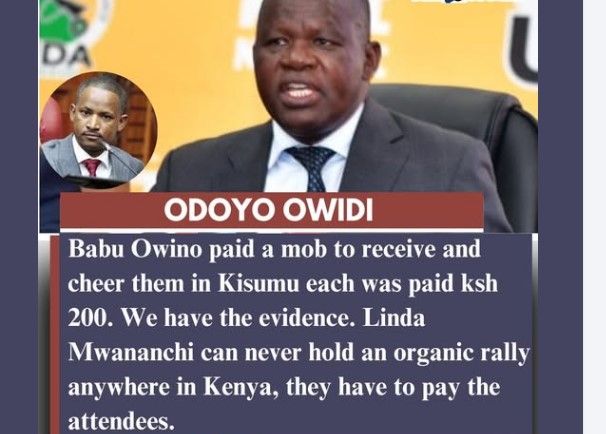
The claim attributed to Odoyo Owidi accusing Babu Owino of paying crowds in Kisumu reflects the kind of sharp, often unverified accusations that are common in Kenya’s political space. Statements like these are serious because they question the authenticity of public support, but they also require solid, verifiable evidence before they can be treated as fact.
In Kenyan politics, especially around rallies and mobilization, it’s not unusual to hear allegations of “hired crowds.” Across parties—including groups linked to movements like “Linda Mwananchi”—supporters and critics frequently accuse each other of staging events. However, without independent confirmation from credible media or documented proof, such claims remain allegations rather than established truth.
For a figure like Babu Owino, who has a strong following particularly among youth, large turnouts can be interpreted in different ways depending on political alignment. Supporters may see it as genuine popularity, while opponents may dismiss it as orchestrated. This divide is part of the broader political contest over influence and public perception.
What matters most is how such claims are handled. Accusations of paying crowds, if true, would raise ethical concerns about transparency and democratic engagement. But if untrue, they risk spreading misinformation and deepening political polarization. That’s why it’s important to rely on credible reporting, documented evidence, or official investigations before drawing conclusions.
In the current environment, where viral statements spread quickly online, the safest approach is to treat such remarks as political opinion or rhetoric until proven otherwise.