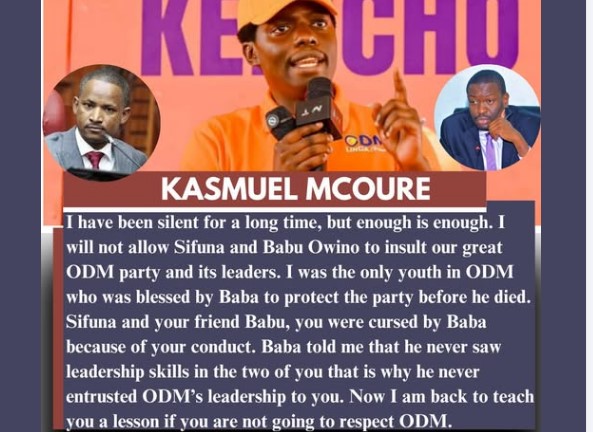
The recent statement attributed to Kasmuel McOure, in which he vows to confront Edwin Sifuna and Babu Owino, highlights the growing tension and internal friction within Orange Democratic Movement. Whether authentic or exaggerated, such remarks reflect a broader pattern in Kenyan politics where loyalty, leadership struggles, and public perception often collide in dramatic fashion.
At the center of this controversy is the symbolic figure of Raila Odinga, popularly known as “Baba.” For years, he has been the ideological anchor of ODM, commanding both respect and influence across generations. His role in shaping the party has created a strong culture of loyalty among supporters, especially the youth, many of whom see themselves as defenders of his legacy. It is within this context that individuals like McOure position themselves as protectors of the party’s values and leadership.
However, politics within ODM, like in many parties, is not immune to disagreement. Leaders such as Sifuna and Babu Owino represent a more outspoken and sometimes controversial wing of the party. Their style of leadership, often characterized by bold statements and public criticism, has earned them both admiration and opposition. This tension between established authority and emerging voices is not necessarily a weakness; rather, it can be seen as a sign of a dynamic political environment where ideas are contested and leadership is constantly being redefined.
That said, the language used in the alleged statement—references to “curses,” threats, and claims of exclusive endorsement—raises concerns about the tone of political discourse. Such rhetoric risks shifting attention away from meaningful debate on policies and governance, instead fueling personal rivalries and emotional reactions among supporters. In a country like Kenya, where political narratives can quickly influence public sentiment, responsible communication is essential.
Moreover, the claim that Odinga made certain declarations “before he died” is factually questionable, given that he remains an active figure in Kenyan politics. This inconsistency further underscores the need for citizens to approach viral political content with caution. Social media has become a powerful tool in shaping narratives, but it also amplifies misinformation and unverified claims.
Ultimately, the situation serves as a reminder of the importance of critical thinking in political engagement. Rather than focusing on sensational statements, attention should be directed toward issues that directly impact citizens—economic growth, governance, and accountability. ODM, like any political party, will continue to evolve, and internal debates will play a role in shaping its future. The challenge lies in ensuring that such debates remain constructive, respectful, and grounded in truth.