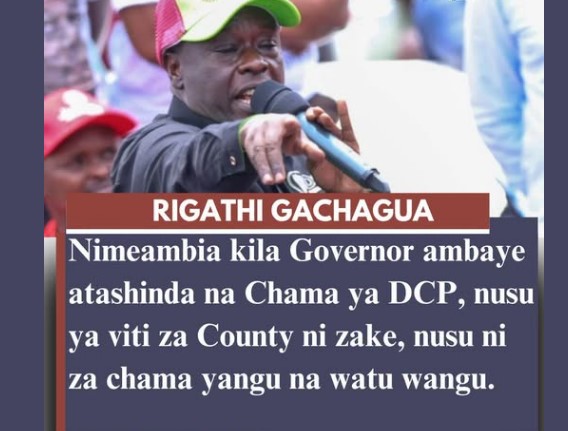
Former Deputy President Rigathi Gachagua has made remarks outlining how political cooperation would work under his alignment with the Democracy for the Citizens Party (DCP). Speaking during a political engagement, Gachagua suggested a power-sharing arrangement between elected county leaders and his party structure.
According to his statement, any governor elected on a DCP ticket would be expected to share county influence, including leadership positions and political appointments. He claimed that half of the county positions would go to the governor’s side, while the other half would be allocated to his party and its supporters. This arrangement, he implied, would ensure balance and representation within county governments.
The remarks highlight the growing political maneuvering ahead of future elections, as leaders position themselves and their parties for influence at both national and county levels. Gachagua’s statement appears to emphasize structured power distribution as a way of maintaining party strength and ensuring that political allies remain integrated in governance.
However, such proposals are often interpreted differently by the public and political observers. Supporters may view the idea as a strategy to promote inclusivity and ensure that party supporters benefit from electoral victories. Critics, on the other hand, may see it as a sign of political bargaining that prioritizes party interests over merit-based governance and service delivery.
The statement also reflects the broader realities of coalition politics in Kenya, where power-sharing agreements frequently shape how governments operate after elections. As political competition intensifies, discussions around resource allocation, appointments, and influence are likely to remain central to campaign rhetoric.
Ultimately, Gachagua’s remarks underscore the strategic nature of political alliances and the importance of party structures in shaping governance outcomes at the county level.