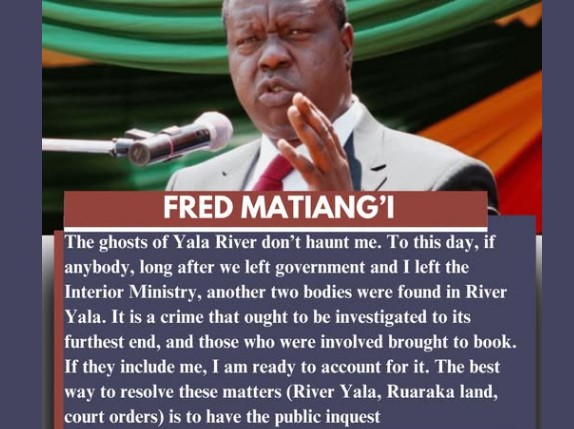
Former Interior Cabinet Secretary Fred Matiang’i has strongly responded to allegations linked to incidents at the Yala River, asserting that he has nothing to hide and is ready to face any form of investigation. His remarks come amid ongoing political tensions involving President William Ruto and other leaders.
Matiang’i dismissed claims connecting him to the bodies that were discovered in Yala River, stating that the issue should not be politicized but instead handled through proper legal and investigative channels. He pointed out that even after he left office at the Ministry of Interior, additional bodies were reportedly found in the river, suggesting that the matter extends beyond his tenure in government.
In his response, Matiang’i emphasized the need for a thorough and transparent investigation. He maintained that the discovery of bodies in the river is a serious criminal matter that deserves full accountability. According to him, anyone found responsible—regardless of their position—should be brought to justice. Notably, he expressed his willingness to be held accountable if investigations reveal any involvement on his part, a statement that underscores his confidence in the legal process.
Beyond the Yala River issue, Matiang’i also referenced other controversial matters such as the Ruaraka land saga and disputes over court orders. He argued that the most effective way to address such complex and sensitive issues is through a public inquest. In his view, an open and transparent process would allow citizens to understand the facts, eliminate speculation, and ensure that justice is served fairly.
His stance has sparked mixed reactions among Kenyans. Supporters view his call for a public inquest as a bold move toward transparency and accountability, while critics argue that the issues raised require swift action rather than prolonged inquiries. Nonetheless, his remarks have added momentum to the national conversation around governance, justice, and the rule of law.
The unfolding debate reflects broader concerns about accountability in public office and the importance of independent investigations. Matiang’i’s response not only defends his personal record but also highlights the need for institutions to handle serious allegations with integrity and openness, ensuring that public trust in governance is maintained.