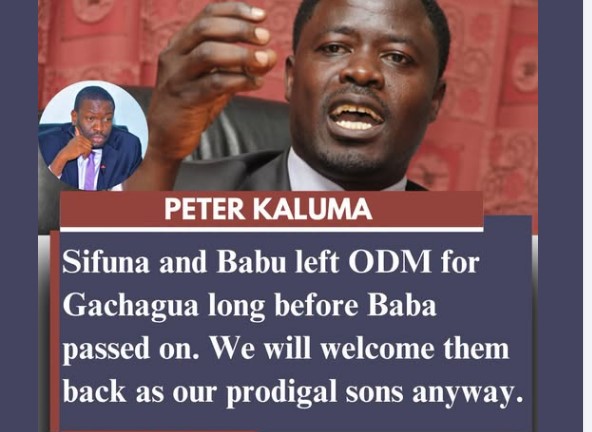
A fresh wave of political tension has emerged within the Orange Democratic Movement (ODM) following remarks by Homa Bay Town MP Peter Kaluma. Kaluma alleged that Edwin Sifuna and Babu Owino had effectively shifted their political allegiance long before the passing of party leader Raila Odinga.
In his statement, Kaluma claimed that the two leaders had aligned themselves with former Deputy President Rigathi Gachagua, suggesting that their loyalty to ODM had diminished over time. His remarks reflect ongoing internal disagreements within the party, as different factions position themselves in Kenya’s evolving political landscape.
Despite the criticism, Kaluma struck a somewhat conciliatory tone by referring to Sifuna and Babu Owino as “prodigal sons,” indicating that they would still be welcomed back into the party. This metaphor suggests that, while differences may exist, there remains room for reconciliation and unity within ODM. It also highlights the fluid nature of political alliances in Kenya, where shifts in loyalty are not uncommon.
The comments have sparked mixed reactions among party supporters and the wider public. Some view Kaluma’s statement as a necessary call for accountability and loyalty within political parties, while others see it as divisive and potentially damaging to party cohesion. The mention of welcoming back the leaders, however, introduces an element of diplomacy, signaling that the door for dialogue remains open.
This development underscores the challenges facing political parties in maintaining unity amid competing interests and ambitions. As Kenya’s political environment continues to evolve, leaders are increasingly required to balance criticism with efforts to preserve cohesion within their ranks.
Kaluma’s remarks therefore not only highlight internal tensions within ODM but also reflect the broader dynamics of loyalty, competition, and reconciliation that shape the country’s political discourse.